Healthcare organizations spend significant time managing claims, denials, staffing, compliance, and operational performance.
But one of the most overlooked threats to financial stability often exists long before a claim is ever submitted:
Insurance contract misalignment.
Many providers sign contracts years earlier and never reevaluate whether those agreements still support the organization’s operational and financial goals.
As reimbursement models continue evolving, this creates hidden revenue risks that quietly impact performance over time.
The Problem Most Providers Never Evaluate
Healthcare reimbursement environments are constantly changing.
Operational costs increase.
Staffing expenses rise.
Compliance expectations evolve.
Payor policies shift.
Authorization requirements expand.
Yet many organizations continue operating under reimbursement structures negotiated under completely different market conditions.
The result?
Providers may unknowingly experience:
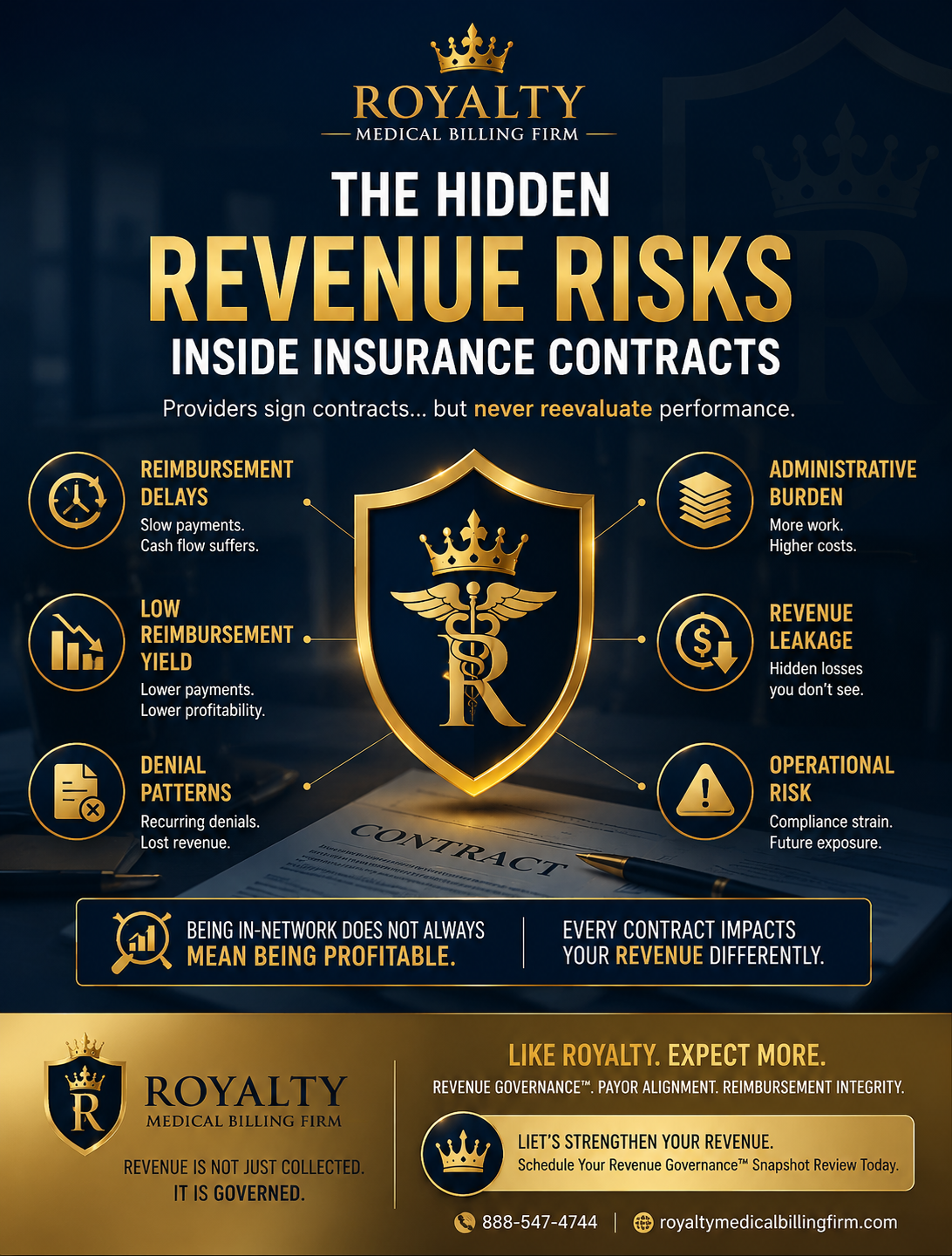
- Low reimbursement yield
- Denial-heavy workflows
- Delayed reimbursement cycles
- Administrative strain
- Revenue leakage
- Contract underperformance
- Poor reimbursement visibility
Not because claims are not being billed —
but because the payor structure itself may no longer be aligned.
Being In-Network Does Not Always Mean Being Profitable
This is one of the largest misconceptions in healthcare revenue management.
Many organizations believe that being contracted with more payors automatically strengthens financial performance.
In reality, not all contracts create operational or financial stability.
Some agreements may:
- increase patient volume while lowering reimbursement quality
- create excessive administrative burden
- produce recurring denial patterns
- delay payment timelines
- increase operational inefficiencies
- reduce overall reimbursement effectiveness
Without ongoing evaluation, providers may normalize underperforming reimbursement structures for years.
Why Payor Alignment Matters
Payor alignment is not simply credentialing or contracting.
It is strategic reimbursement positioning.
It involves evaluating whether insurance relationships support:
- operational efficiency
- reimbursement integrity
- financial performance
- scalability
- compliance stability
- long-term organizational growth
Every insurance contract impacts revenue differently.
That means healthcare organizations require more than billing support.
They require visibility and oversight.
The Hidden Revenue Risks Inside Misaligned Contracts
One of the greatest financial risks in healthcare is silent revenue suppression.
This occurs when organizations continue operating within reimbursement structures that no longer support the true cost of care delivery.
Over time, misalignment can contribute to:
- chronic underpayments
- denial escalation
- workflow inefficiencies
- increased accounts receivable pressure
- reduced cash flow visibility
- operational instability
Unfortunately, many organizations do not uncover these patterns until financial performance begins declining.
Why Traditional Billing Alone Is No Longer Enough
Traditional medical billing models were built around claim processing.
Submit the claim.
Post the payment.
Appeal the denial.
But modern healthcare revenue requires more than transactions.
It requires:
- reimbursement visibility
- contract awareness
- operational oversight
- denial trend analysis
- strategic payor alignment
- financial governance
This is where Revenue Governance™ changes the conversation.
Revenue Governance™ & Strategic Payor Alignment
At Royalty Medical Billing Firm, we help healthcare organizations evaluate the financial impact of reimbursement structures through Revenue Governance™ and strategic payor alignment.
Our focus includes:
- reimbursement visibility
- payor performance evaluation
- denial trend identification
- revenue leakage analysis
- operational alignment
- reimbursement strategy
- financial oversight
Because revenue today is not just collected.
It is governed.
Request a Revenue Governance™ Snapshot Review
Our Revenue Governance™ Snapshot helps healthcare organizations identify hidden reimbursement risks, alignment gaps, and operational inefficiencies across the revenue cycle.
📞 888-547-4744
🌐 Royalty Medical Billing Firm
#RevenueGovernance #PayorAlignment #HealthcareFinance #MedicalBilling #RevenueIntegrity #RevenueCycleManagement #HealthcareLeadership #InsuranceGovernance #PracticeManagement #HealthcareBusiness
Leave a Reply