Healthcare organizations spend years negotiating insurance contracts, yet many providers never fully evaluate how those agreements actually perform once claims begin processing.
The reality is this:
A signed contract does not guarantee accurate reimbursement.
Across PPOs, HMOs, Medicare Advantage plans, and capitation agreements, healthcare organizations often face hidden operational and financial risks that slowly impact revenue performance over time. Unfortunately, many of these issues remain unnoticed until reimbursement declines, denials increase, or cash flow becomes unstable.
This is where Revenue Governance™ becomes essential.
The Hidden Risks Inside Insurance Contracting
Most providers assume reimbursement issues begin with billing errors. In reality, many problems originate much earlier — within the contract structure itself.
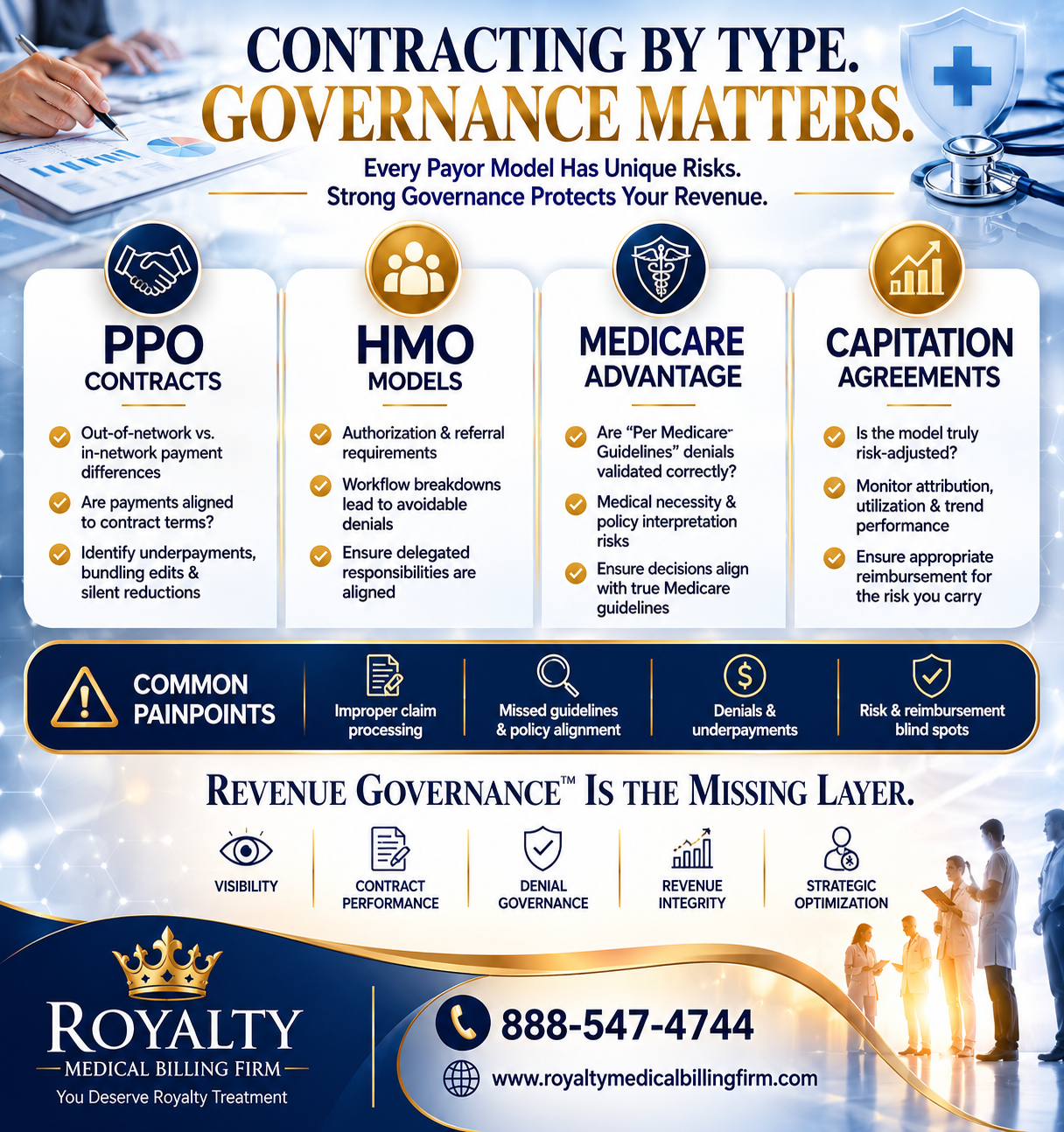
PPO Contracts
Providers frequently experience:
- Out-of-network vs. in-network reimbursement inconsistencies
- Silent reductions tied to Medicare-based calculations
- Underpayments hidden within fee schedule variances
- Bundling and payment edits reducing reimbursement unexpectedly
Without governance oversight, these discrepancies often go unidentified.
HMO Models
HMO structures introduce operational complexity that directly affects reimbursement:
- Authorization workflow breakdowns
- Referral processing issues
- Delegated responsibility confusion
- Preventable denials caused by administrative misalignment
When operational governance is weak, reimbursement performance suffers.
Medicare Advantage
One of the most common denial explanations providers receive is:
“Per Medicare Guidelines.”
However, many organizations never validate whether those denials truly align with Medicare policy interpretation, documentation standards, or medical necessity requirements.
This creates significant reimbursement risk.
Capitation Agreements
Capitation models require ongoing visibility and evaluation:
- Is the model truly risk-adjusted?
- Are patient attribution patterns accurate?
- Are utilization trends aligned with reimbursement performance?
- Is the organization carrying more financial risk than the contract supports?
Without performance governance, organizations may unknowingly absorb unsustainable financial exposure.
Revenue Governance™ Changes the Conversation
Traditional billing focuses on processing claims.
Revenue Governance™ focuses on visibility, oversight, alignment, and performance.
At Royalty Medical Billing Firm, we help healthcare organizations evaluate:
- Payor alignment
- Contract performance
- Denial governance
- Reimbursement integrity
- Revenue leakage
- Financial visibility across the revenue cycle
With over 20 years of experience solving complex reimbursement and insurance alignment challenges, we understand that protecting revenue requires more than billing.
It requires strategy.
The Bottom Line
Insurance contracts rarely favor providers without oversight.
The organizations that succeed financially are the ones that actively govern reimbursement performance, validate contract execution, and identify hidden revenue risks before they become operational problems.
Because contracts alone do not protect your revenue.
Governance does.
Request your complimentary Revenue Governance™ Review today.
📞 888-547-4744
🌐 www.royaltymedicalbillingfirm.com
#RevenueGovernance #HealthcareFinance #MedicalBilling #PayorAlignment #InsuranceContracting #HealthcareLeadership #RCM #RevenueIntegrity #MedicareAdvantage #Capitation #PPO #HMO
Leave a Reply