Many healthcare organizations assume that if claims are being paid, the revenue cycle is functioning properly.
But reimbursement accuracy and revenue optimization are not the same thing.
This is one of the most overlooked problems in modern healthcare finance.
The Dangerous Assumption in Healthcare Billing
Most providers monitor:
- Whether claims were submitted
- Whether payments were received
- Whether AR is moving
But few organizations actively monitor:
- Whether reimbursement aligns with contract expectations
- Whether payments are underpaid
- Whether coding opportunities are being missed
- Whether workflow gaps are reducing collections
- Whether denials indicate larger operational issues
The difference between “paid” and “paid correctly” can represent substantial revenue loss over time.
Why Review Processes Matter
Healthcare reimbursement is no longer predictable.
Payor behavior changes constantly.
Policies evolve.
Fee schedules shift.
Compliance standards tighten.
Automation systems create inconsistencies.
Operational gaps compound silently.
Without a structured review process, providers may never identify:
- Chronic underpayments
- Incorrect adjudication patterns
- Denial trends
- Insurance contract weaknesses
- Revenue workflow inefficiencies
This is why organizations need continuous review systems — not just claim submission services.
The Problem With Reactive Billing
Most billing operations are reactive by design.
A denial happens.
Then it gets addressed.
A payment issue appears.
Then someone investigates.
But reactive systems often allow revenue issues to continue for months — sometimes years — before they are identified.
Governance-based revenue models create proactive oversight.
That means:
- Reviewing reimbursement patterns before major loss occurs
- Identifying vulnerabilities early
- Monitoring payment trends continuously
- Revising workflows strategically
- Aligning operations with financial performance goals
This is the difference between processing revenue and managing it strategically.
Why Providers Need Structural Revenue Revision
In many organizations, revenue issues are not caused by one major failure.
They are caused by small inefficiencies across the system:
- Incomplete workflows
- Improper coding patterns
- Weak insurance alignment
- Lack of reporting visibility
- Aging process structures
- Inconsistent oversight
Over time, these inefficiencies create operational instability.
This is why healthcare organizations periodically need structural revenue review and revision processes.
Not because the system is “broken” —
but because reimbursement environments continuously evolve.
Royalty Medical Billing Firm’s Approach
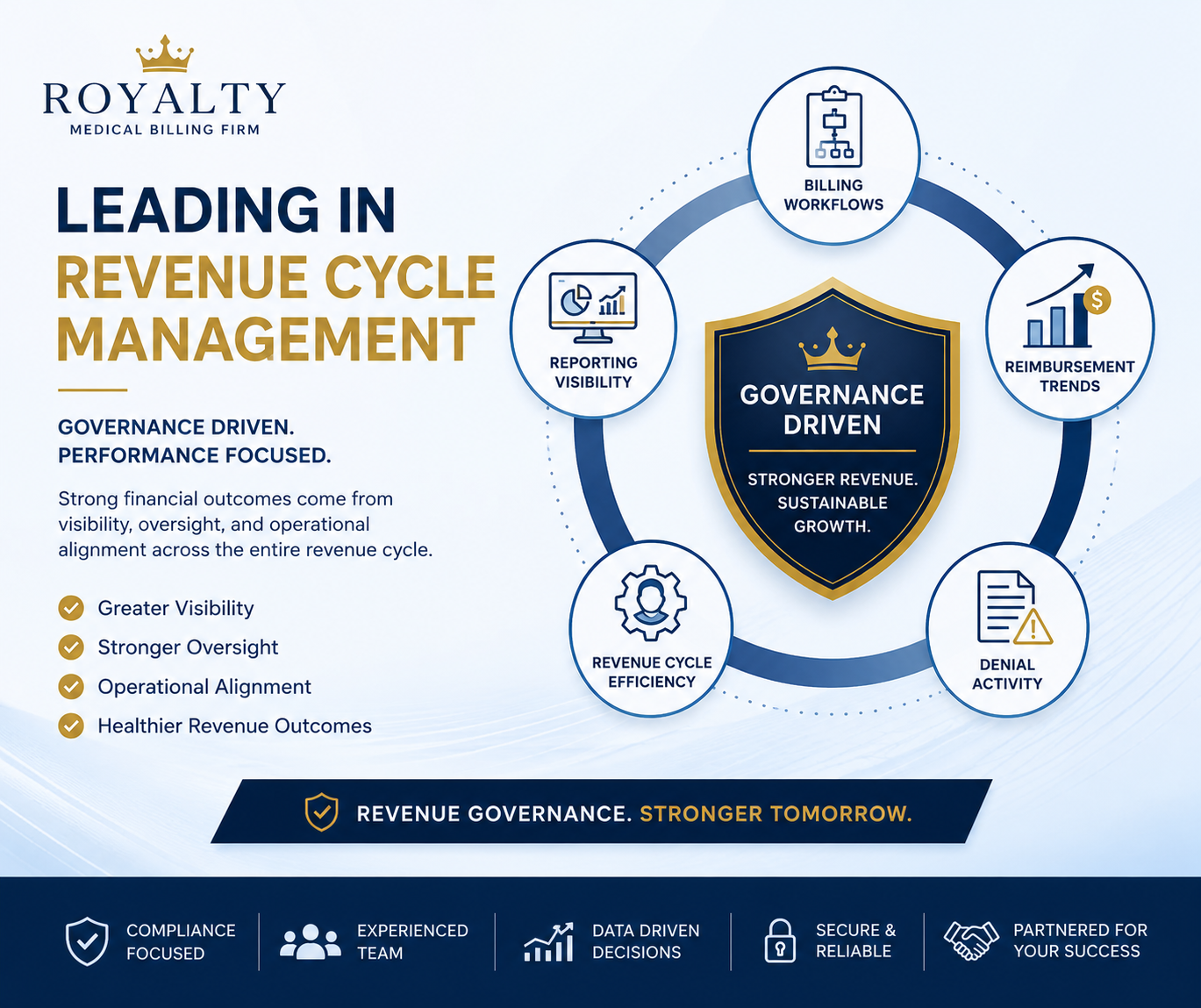
At Royalty Medical Billing Firm, we approach revenue through governance, oversight, and strategic visibility.
We help healthcare organizations evaluate:
- Payor performance
- Revenue structure
- Workflow alignment
- Reimbursement integrity
- Contract positioning
- Operational vulnerabilities
- Compliance-focused revenue systems
Our goal is not simply to submit claims.
Our goal is to help organizations create stronger, more controlled revenue environments.
Revenue Requires Oversight
Healthcare revenue has become too regulated, too data-driven, and too contract-dependent to operate without governance.
Organizations that prioritize review, revision, oversight, and visibility position themselves for stronger long-term performance.
Because in today’s environment:
Revenue should never be left unmanaged.
It should be governed.
Request Your Revenue Governance™ Snapshot
Our Revenue Governance™ Snapshot helps providers identify hidden risks, reimbursement gaps, and operational inefficiencies across the revenue cycle.
📞 888-547-4744
🌐 Royalty Medical Billing Firm
Leave a Reply