Artificial intelligence is changing healthcare revenue cycle management.
Across the industry, more medical billing platforms are promoting AI-driven automation, faster claim processing, denial prediction, coding support, reporting dashboards, and workflow alerts. These tools can be helpful when used correctly. They can reduce manual tasks, organize data, and support faster decision-making.
But there is one important truth healthcare organizations should understand:
AI can process information, but it cannot fully govern your revenue cycle.
That is where the difference begins.
At Royalty Medical Billing Firm, we believe AI should be used as a tool — not as the driver of the entire billing operation. Technology can support the revenue cycle, but strategy, oversight, payer knowledge, contract awareness, compliance judgment, and operational accountability still require human expertise.
The Rise of AI-Driven Medical Billing Platforms
AI-driven billing platforms are designed to help automate parts of the revenue cycle. Many of these systems focus on speed, data organization, claim edits, denial alerts, payment tracking, and workflow efficiency.
These platforms may assist with:
• Claim scrubbing
• Coding suggestions
• Denial prediction
• Payment trend reporting
• Eligibility checks
• Workflow automation
• AR tracking
• Dashboard visibility
These tools can provide value, especially when a practice has strong processes already in place. However, automation alone does not guarantee revenue accuracy, payer alignment, or financial performance.
A system can move claims quickly and still miss the bigger picture.
The Limitation of AI-Driven Billing
AI platforms are only as strong as the structure behind them.
If a practice has weak workflows, unclear payer processes, poor documentation habits, outdated contract awareness, or inconsistent denial management, AI may only automate the same problems faster.
That means a practice could still experience:
• Repeated denials
• Underpaid claims
• Missed reimbursement opportunities
• Weak payer alignment
• Contract payment inconsistencies
• Workflow breakdowns
• Reporting without interpretation
• Revenue leakage that remains hidden
AI can identify patterns, but it does not always understand the business context behind those patterns.
For example, an AI platform may show that denials are increasing. But the deeper question is: Why are they increasing?
Is it a documentation issue?
A payer policy change?
A contract problem?
A coding trend?
A front-end workflow gap?
A staff training issue?
A missing authorization process?
That level of review requires governance.
Our Advantage: AI as a Tool, Not the Decision-Maker
At Royalty Medical Billing Firm, we do not reject technology. We use technology strategically.
Our advantage is that we combine billing knowledge, payer awareness, operational review, and revenue governance with technology-supported insights.
Instead of allowing AI to drive the process, we use AI and automation to support:
• Data review
• Trend identification
• Workflow organization
• Reporting visibility
• Denial pattern recognition
• Revenue cycle monitoring
• Administrative efficiency
But the strategy, interpretation, and decision-making remain guided by experienced human oversight.
That is important because healthcare revenue is not just technical. It is operational, contractual, regulatory, and financial.
Why Human Oversight Still Matters
Medical billing is not only about submitting claims. It involves understanding how multiple parts of the revenue cycle connect.
Human oversight is still needed to evaluate:
• Whether payer payments align with expected reimbursement
• Whether denials reflect a deeper workflow issue
• Whether contracts are performing as expected
• Whether documentation supports billing accuracy
• Whether coding patterns are creating risk or missed opportunity
• Whether AR is aging due to process breakdowns
• Whether reports are showing activity or true performance
AI can support this work, but it cannot replace the need for structured review and professional judgment.
A dashboard may show data.
Governance explains what the data means.
The Difference Between Automation and Governance
Automation focuses on completing tasks faster.
Governance focuses on making sure the right tasks are being monitored, measured, and aligned.
That difference matters.
A traditional AI-driven platform may focus on:
• Faster claims
• Automated edits
• Alerts and dashboards
• Workflow routing
• Basic denial prediction
A governance-driven approach focuses on:
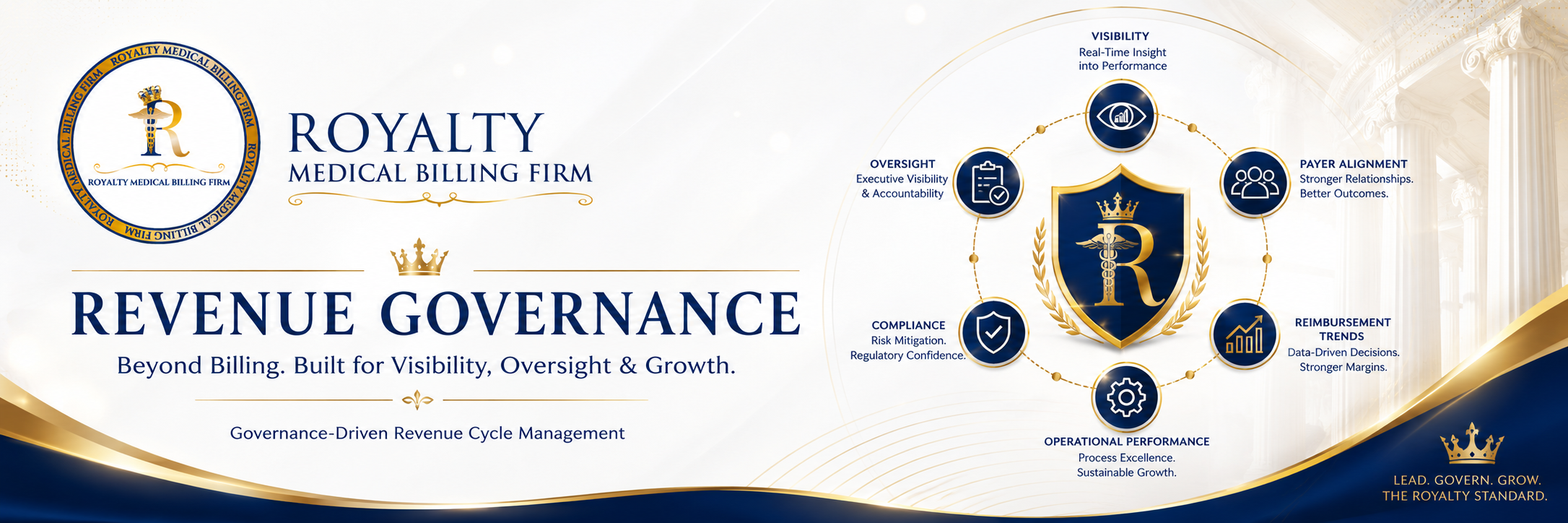
• Revenue visibility
• Payor alignment
• Contract awareness
• Denial root cause review
• Workflow accountability
• Reimbursement oversight
• Operational structure
• Long-term financial performance
Both can be valuable. But technology without governance can leave major gaps uncovered.
Why Practices Should Be Careful With Fully AI-Driven Billing
Fully AI-driven billing may sound efficient, but healthcare organizations should be cautious about relying too heavily on automation without expert oversight.
Revenue cycle management involves judgment. It involves understanding payer behavior, specialty-specific billing rules, documentation standards, contract terms, and operational patterns.
A system may flag a denial.
But someone still needs to determine whether the denial is isolated, preventable, payer-specific, contract-related, documentation-based, or part of a larger revenue issue.
Without that review, a practice may only treat the symptom instead of solving the root problem.
Our Governance-Driven Technology Approach
Royalty Medical Billing Firm takes a balanced approach.
We believe the future of revenue cycle management is not “AI vs. people.”
It is technology plus governance.
Our approach supports healthcare organizations by combining:
• Medical billing knowledge
• Coding and documentation awareness
• Payor alignment review
• Insurance contract awareness
• Denial trend analysis
• Workflow evaluation
• Revenue cycle reporting
• AI-supported tools and automation
• Human-led revenue oversight
This allows us to use technology where it strengthens the process, while still protecting the organization from relying on automation alone.
What Separates Royalty Medical Billing Firm
What separates us from fully AI-driven billing platforms is our leadership approach to revenue performance.
We do not simply allow technology to run the process.
We use technology to support a structured revenue governance model.
That means we look beyond the claim and evaluate the full revenue system, including:
• How the workflow is structured
• How payer requirements are being monitored
• How denials are being reviewed
• How reimbursement trends are being interpreted
• How contract performance is being tracked
• How reporting is being used to support decisions
• How leadership can gain clearer visibility into revenue performance
Our goal is not just faster processing.
Our goal is stronger financial oversight.
Final Thought
AI is a powerful tool in medical billing, but it should not replace strategy, judgment, or governance.
Healthcare organizations need more than automation. They need visibility, interpretation, alignment, and accountability across the revenue cycle.
At Royalty Medical Billing Firm, we use technology to support smarter billing operations — but our advantage is that we do not allow technology to replace human expertise.
Because revenue should not be controlled by automation alone.
Revenue should be governed.
Royalty Medical Billing Firm
Governance-Driven Revenue Cycle Management. Technology-Supported. Human-Led.
📞 888-547-4744
🌐 www.royaltymedicalbillingfirm.com
Leave a Reply